
'Nawaz Sharif knows a coup in 2016-2017 will not only complete Pakistan's isolation, but even a whiff of instability will frighten the world into imagining another Islamic State-zone, and this in a fully nuclearised subcontinent,' says Shekhar Gupta.
The world according to Neeraj Pandey. Observed by Sreehari Nair.

The government on Tuesday said it was in touch with the Indian nurses stranded in violence-hit Tikrit town in Iraq and assured "every possible help" to Indian citizens in the trouble-torn country.
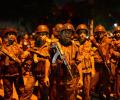
'I have noticed how a certain country wants to establish the presence of ISIS in Bangladesh.' 'Are these terrorists working under some religious inspiration or they are being lured by an obnoxious amount of money?' 'For some mysterious reasons, no action is taken by the government against suspicious organisations.'
Some of the big moments of the sporting world from 2010-2019!
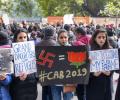
'The protests have forced the government to announce that the NRC is not an immediate priority.' 'Even if they are trying to pursue this policy in a different guise, through the NPR, the fact that they have been forced to pause and backtrack at least temporarily shows the positive impact of the protests.' 'Moreover, various state governments have opposed the NPR which cannot be carried out without their cooperation. That is also a success of the protests.' 'The state governments would not have taken this stance against the central government if their hand had not been forced by the popular mood.'

United States President Barack Obama will convene a meeting of the UN Security Council next month on the threat posed by foreign fighters in Syria and Iraq, the White House has said, amidst reports that another American jihadi has died in Syria fighting for Islamic State of Iraq and the Levant.

'The Muslim identity of the family appears incidental to the subject of the film...' 'The self-sacrificing, suffering mother film could have belonged to any religion.' 'The abusive father, who prefers his son to his daughter, could have followed any religion.' 'That the Muslim household is remarkably free from religious symbolism is also the strength of the film,' feels Mohammad Asim Siddiqui.

Rediff.com's Indrani Dey digs up chilling details of the ongoing investigation in the Bardhaman blast case, which exposed the a militant network that had been operating in West Bengal since many years.

Everything about ISIS had indicated that this would be a violent Ramzan. A violent, divisive Ramzan sends out exactly the message that ISIS wants to send to religious Muslims outside its folds: It plays on their faith and fears, says writer Tabish Khair.

'It was a mission undertaken in darkness in every sense -- literally, because Afghanistan had no electricity at that time; and, metaphorically because Delhi historically dealt only with the Pashtuns of Afghanistan and the foreign ministry's vast archives had nothing to offer on the culture and politics of the northern tribes in the Hindu Kush.'

Aseem Chhabra introduces us to the best of Berlinale.

As politicians fast to score brownie points, they should know that not every fast has a desirable ending, says Arundhuti Dasgupta.

Even as the polity find ways and means to address the genuine concerns and fears of the society, the Sri Lankan State apparatus would have to unravel these mystery-questions with convincing answers, and a road-map to the future, says N Sathiya Moorthy.
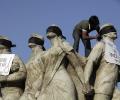
Bangladesh's main opposition Bangladesh Nationalist Party's three top women leaders were arrested on the second day of the 'democracy march' on Monday, as clashes erupted inside the supreme court premises between pro- and anti-government lawyers.

The two PMs called upon all countries to work towards rooting out terrorist safe havens and infrastructure.

For the family and supporters of blogger Avijit Roy, who was hacked to death in Dhaka in February, it is a time to reflect on where Bangladesh is heading, says Indrani Roy.

The man behind Aligarh Muslim University 200 years on.

'This is basically aimed at vilifying Nehruvian ideals.' 'Why?' 'Because, Nehruvian leadership is seen by Hindutva forces as the one which did not let them have their Hindu Raj.' 'The Hindutva proponents have always assumed that had Sardar become the first prime minister, India could never have become a secular State,' says Mohammad Sajjad.

'Omar Khorsani has called repeatedly for the most barbaric of attacks. He is very adept on social media. He is, in other words, eerily similar to the ISIS leader Baghdadi.' 'The crux of the army's 'strategic asset' policy -- its policy of regarding militants as those that can help Pakistan pursue its regional interests -- is that Pakistan needs help in weakening India or in keeping its presence minimal in the region.' Michael Kugelman reveals what the world can expect next from the Tehreek-e-Taliban Pakistan, the terrorists responsible for the Peshawar school massacre.

Colonel Anil Athale (retd) recalls how the Battle of Panipat, 258 years ago, changed the history of India for the next century and half.
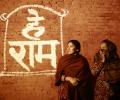
During the hearing, Chief Justice of India JS Khehar also offered to serve as a mediator, if negotiations broke down.
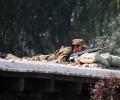
Pakistan faces a challenge largely of its own creation and only political processes can correct it, argues Raza Rumi.

'Communalism and communal riots happened in India only during and due to colonialism. Pre-colonial India didn't have this problem of communal conflicts and religious strife.'

Historian Stanley Wolpert, author of several books on India, passed into the ages recently. We remember Professor Wolpert with Rajeev Srinivasan's March 1997 interview published on the occasion of his controversial book on Jawaharlal Nehru.

Those familiar with Hindi poetry are aware of Rahim's elevated status in the medieval history of literature -- he is one of the triumvirate of doha writers, the other two being Kabir and Tulsidas.

The year 2014 is coming to an end. It was the year of conflict, the year of strife. Year 2014 will be remembered for several reasons -- the rise and threat of the Islamic State, the downing of two Malayasia Airlines aircraft and the sudden and effective way of using hastags on social media to generate a buzz about the event. After all, who can forget #theicebucket challenge and the phenomenon it grew into. Read on as we bring you an overview of international news and events of 2014.

The developments in Af-Pak region, particularly the fall out of Pak political paralysis, would make President Xi Jinping's task a little more complicated, says Colonel R Hariharan.

A five-judge Constitution bench headed by Chief Justice J Khehar will commence hearing on seven petitions

Talmiz Ahmad is a former Indian ambassador to Saudi Arabia, Oman and the UAE. In an interview with Aditi Phadnis, he says the disequilibrium in Iraq will continue to prevail. Ahmad also says there are indications that the US is now anxious to avoid intervening militarily in West Asia, and that this is the appropriate moment for Asia to assume responsibility for its own security. Edited excerpts:

The NDA candidate tells the Election Commission that the Maoists plan to kidnap him.
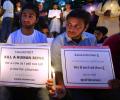
'Most Hindus believe in living in peace with their Muslim neighbours and vice versa.' 'It is this India we have to preserve.'

'The strategy has to be restoring order in one part and countering the very effective propaganda through a very nimble monitoring and response system,' says Lieutenant General Syed Ata Hasnain, who retired as the General Officer Commanding of the Srinagar-based 15 Corps.
'I have been a court reporter for many years and have not seen such blatant suppression of those who are fighting for human rights, suppression of freedom of expression, and linking it to terrorism.'
'Terrorism is merely a symptom of a deeper disease in Pakistan's body politic,' says Colonel Anil A Athale (retd).

Mohammad Sajjad salutes the memory of Mushirul Hasan -- historian, thinker, academic, institution builder, -- who passed into the ages this week.

The US on Tueday released new set of documents that it recovered from the Abbottabad hideout of al-Qaeda leader Osama bin Laden.

'In the name of pluralism-secularism, the kind of politics that was pursued revealed to many that it was basically a favour to Muslim conservatism and communalism -- a politics of minority-ism, rather than of secularism.' 'This is how significant sections of Hindus have been made to loathe the very idea of Indian secularism by now,' says Mohammad Sajjad.

'Ashok Singhal was an amazing missionary, a monk in civil dress. His personal ego and pride simply evaporated before the national cause.'

Mohammad Sajjad profiles Professor Riazur Rahman Sherwani, 94, versatile mind, intrepid intellectual.
